Sargassum does not affect the Mexican Caribbean evenly. The coastline changes direction every few kilometres, and rocky points that extend into the sea shelter some bays from wind and current while leaving the next one exposed.
We document each of these beaches on the live map and in an individual guide for every beach we cover. The question we are asked most often is which beaches we would choose ourselves.
Here are our five, drawn from Cancún, Isla Mujeres, the Riviera Maya and Cozumel.
How we ranked them
We ranked each beach on four criteria, in order of weight:
How consistently the beach stays clear and swimmable. This carries by far the most weight. A beach that is unusable six months a year is not a reliable recommendation.
The colour and clarity of the water across the year. Typical conditions, not the best day.
Facilities. Bathrooms, showers, shade, play areas for children, and parking.
Accessibility. Travel time, the cost of a bus, taxi or ferry, opening hours, and whether the beach is genuinely public or only reachable through a resort.
The first two determine the ranking; the last two separate close contenders. Each entry links to its beach card, with the current reading and dated photographs.
5. Punta Cancún
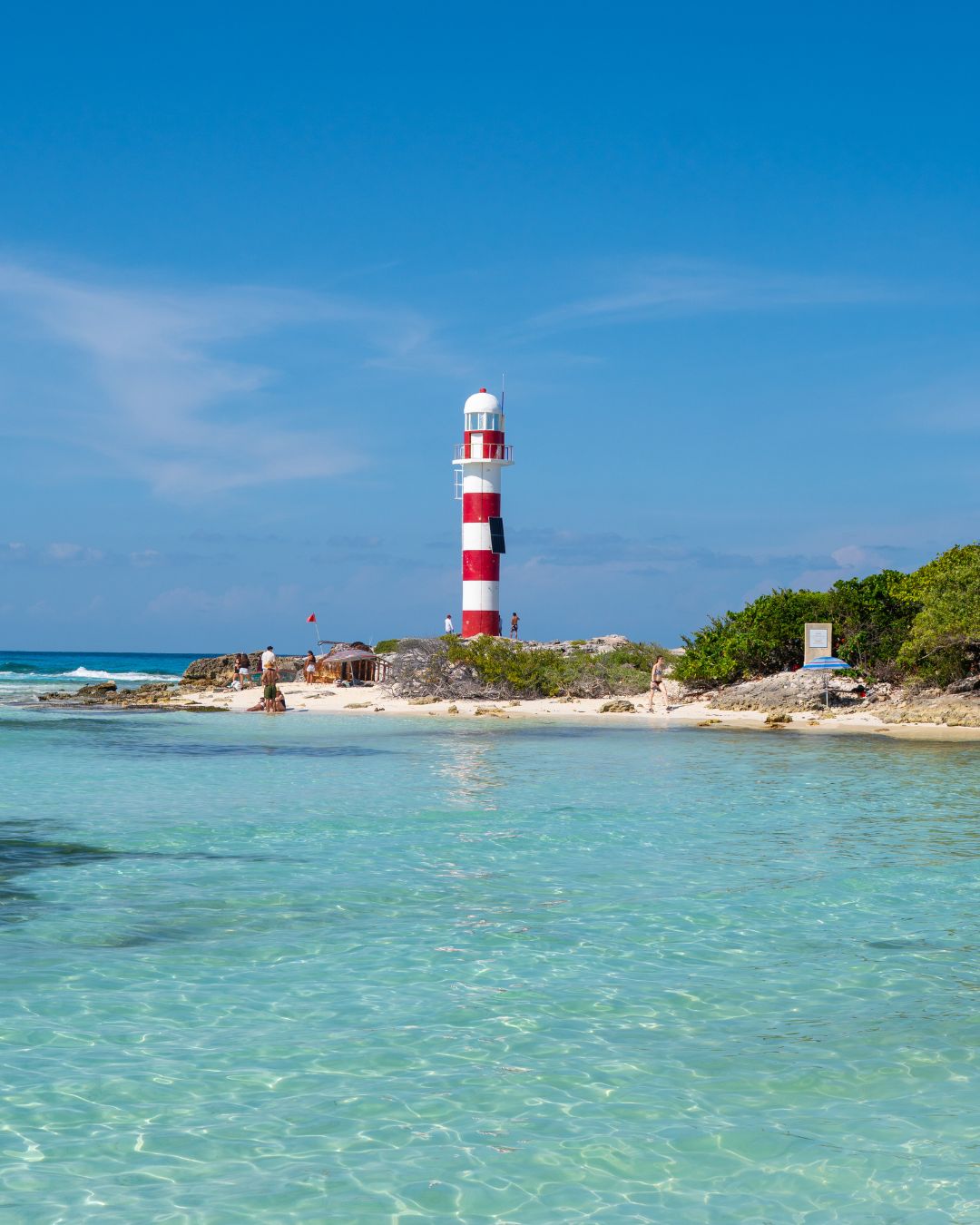
Punta Cancún is the point where the hotel zone turns from facing north to facing east. Its water is a clear turquoise, unusual for a beach with a city directly behind it.
Its north-facing side looks into the bay between Cancún and Isla Mujeres rather than the open sea, which makes it one of the most sheltered beaches in Cancún, along with Playa Caracol, Playa Langosta and Playa Tortugas. The east-facing beaches further south face the current directly and collect more sargassum.

The beach is split into small sections between the hotels and the rocks of the point, so the footing is uneven in places and water shoes help. There is no verified public car park, which is the main reason it does not rank higher: without a nearby hotel, it is more difficult to reach. The R-1 and R-2 buses run the length of Boulevard Kukulcán, and the point has the hotel zone's largest cluster of plazas, restaurants and nightlife within walking distance.
Hotels on this stretch include the Grand Fiesta Americana Coral Beach, the Hyatt Regency Cancún, Breathless Cancún Soul and the Hyatt Ziva Cancún.

See the live card for Punta Cancún →
4. Costa Mujeres
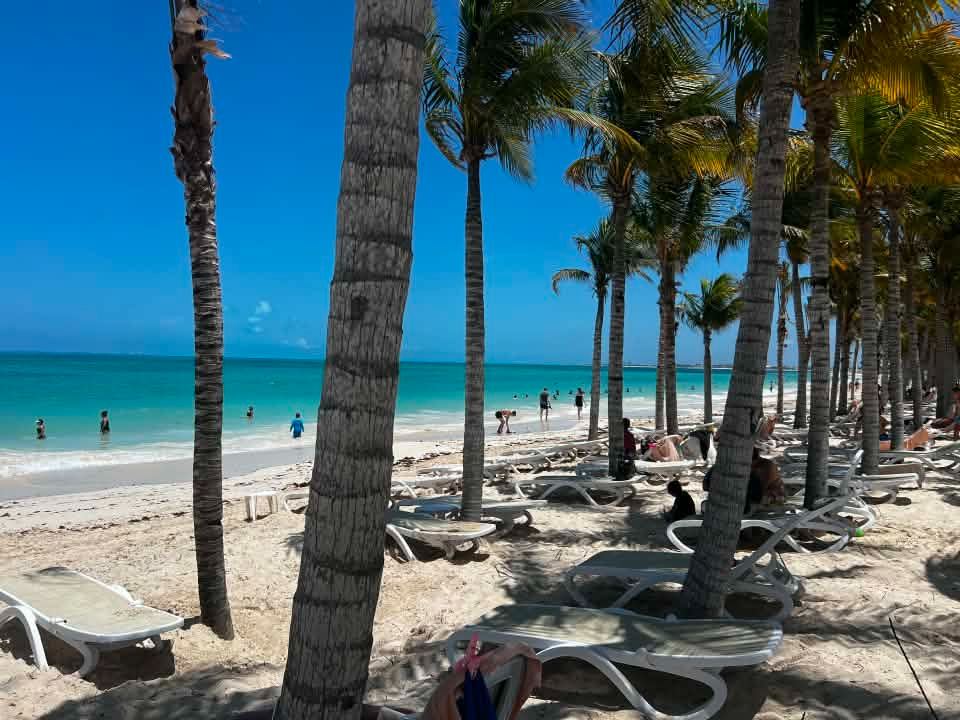
Costa Mujeres is the stretch of coast north of Cancún, beyond Punta Sam. It is the region's newest resort area, still being built out with large modern properties. Its advantage is orientation: it faces the sheltered side rather than the open sea, and receives noticeably less sargassum than the coast further south.
It also recovers quickly. Sargassum reaches this coast on the Yucatán Current, which runs north-west along the eastern shore of Quintana Roo, so when it arrives it usually clears within days. That holds through June, July and August, when the gap between this coast and others is widest.
Access to the beaches is private, so they are less crowded and quiet. Access is the drawback. There is no public beach car park along this coast, and buses reach Puerto Juárez and Punta Sam but not the resort area further north. The road runs north from Cancún past the vehicle ferry terminal. Facilities depend on your resort, so this coast does not suit day visits.
Resorts along this stretch include Riu Palace Costa Mujeres, Grand Palladium Costa Mujeres, TRS Coral Hotel, Majestic Elegance Costa Mujeres and Secrets Playa Blanca.
See the live card for Costa Mujeres →
3. Playa Langosta

Playa Langosta is our first choice for families, and it has the best facilities of the five.
The water is pale turquoise over the shallows and deep blue further out, with a sharp line between the two. There is almost no current, and the shallows extend far enough to suit children and less confident swimmers.
The beach is public and free, with bathrooms, showers and a children's playground. Parking is free, and the R-1 and R-2 buses stop directly outside on Boulevard Kukulcán. The car park is small and fills early on Sundays, so arrive in the morning or take the bus. Playa Tortugas, 1.5 km north, has the Isla Mujeres passenger ferry and more restaurants.
It would rank higher without the occasional sargassum, as in early September. It holds third because it recovers quickly, like the rest of north Cancún.
Hotels on the stretch include Riu Palace Peninsula, Riu Caribe, Meliá Casa Maya Cancún, Sens Cancún and Grand Oasis Palm.
See the live card for Playa Langosta →
2. Punta Sur and Garrafón, Isla Mujeres
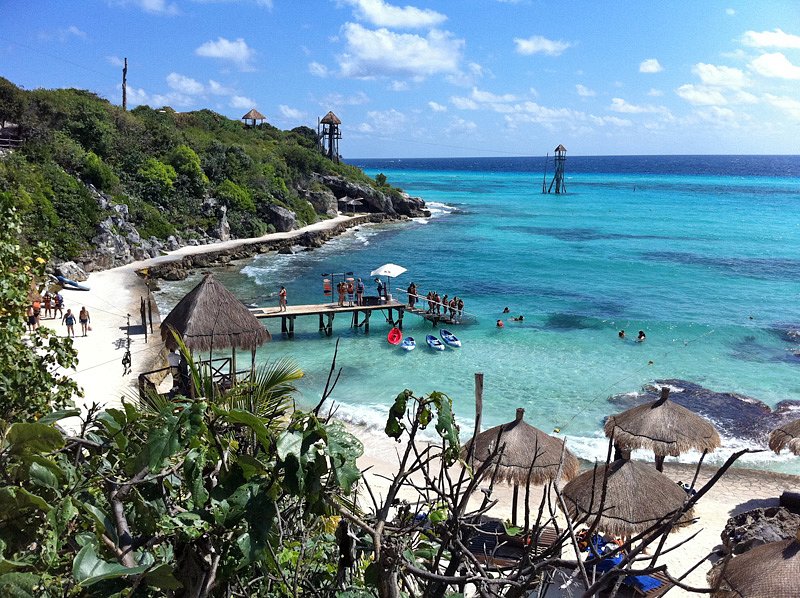
The southern end of Isla Mujeres is the most dramatic coast in this ranking, with the clearest water. The island narrows into cliffs, the seabed drops away close to shore, and the reef is near enough to see fish from the surface. On a calm morning you can see the bottom from the rocks.
Punta Sur is the island's southern tip, the easternmost point in Mexico and the first place in the country to see the sunrise. A clifftop path leads through a sculpture garden to a lighthouse and the remains of a Maya temple dedicated to Ixchel, with the sea on three sides. It is a viewpoint and a walk rather than a swimming beach.
For swimming, there are two options side by side just up the coast.
Parque Garrafón is a commercial park. A paid day pass covers snorkelling, kayaks, hammocks over the water, an infinity pool overlooking the sea, lockers and showers, with zip lines at extra cost. It opens later and costs more, but the reef access is real and the setting is the best on the island. Our full guide to Parque Garrafón covers what the ticket includes and the dock fee many visitors miss.
Garrafón de Castilla is a smaller beach club next door at a fraction of the price: a small sandy beach, snorkel rental, clean bathrooms, lockers, showers and the same water. It opens earlier. Shade is limited, so the trees are taken first. The water deepens quickly, so less confident swimmers should wear a life jacket, and water shoes help on entry.
Both are reached by ferry to Isla Mujeres, then a ten-minute taxi or a golf cart from the terminal. The island is under 8 km long, so a cart covers it in a morning, which is how most visitors combine Punta Sur, Garrafón and Playa Norte in one day. That is also the drawback: with a ferry and onward transport, it is a day you plan in advance.
See the live card for Punta Sur → · Garrafón de Castilla →
1. Playa Norte, Isla Mujeres
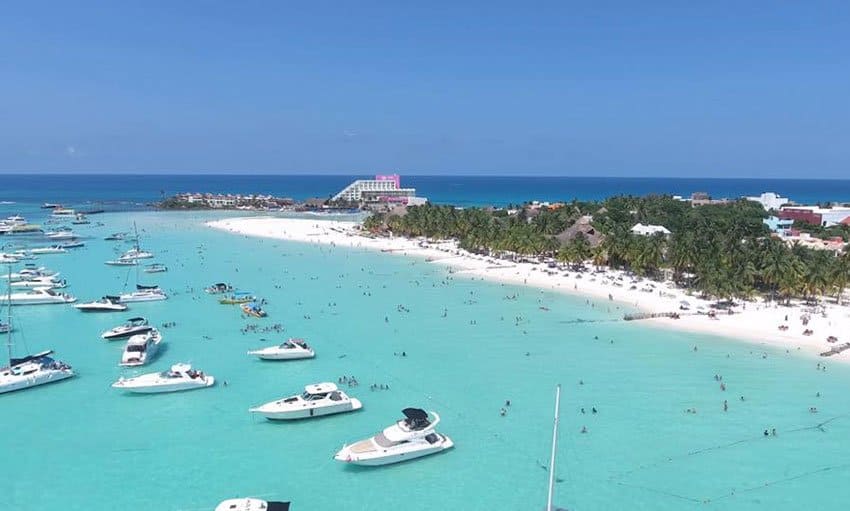
Playa Norte, on the northern tip of Isla Mujeres, scores best on all four criteria. It faces the sheltered side of the island, away from incoming sargassum, which makes it, with the south of the island, one of the most consistently clear beaches in the region. In the worst weeks of the season, when the coast from Playa del Carmen to Tulum gets sargassum daily, Playa Norte usually stays clean.
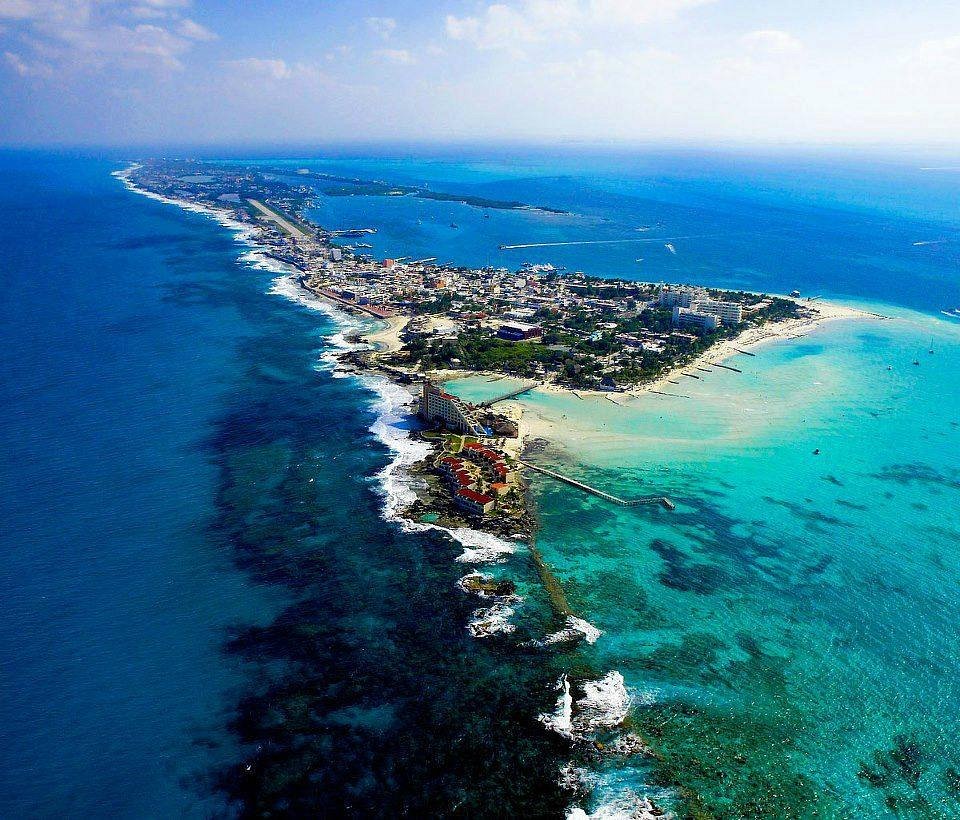
Its water is the shallowest and palest on this list, knee-deep a long way out, with no drop-off and no current. It is the most photographed beach in the Mexican Caribbean, and deservedly so.
The beach is public and free. Beach clubs and restaurants rent loungers, and the town centre is a short walk away for bathrooms, food and shade. Passenger ferries run from Puerto Juárez, Punta Sam and Playa Tortugas. From the terminal the beach is within walking distance, and golf carts can be rented on the island.
Hotels on the beach itself include Mia Reef Isla Mujeres, which sits on its own small peninsula with water on both sides, Privilege Aluxes, Izla Beach Front Hotel, Ixchel Beach Hotel and Hotel Villa Kiin.
See the live card for Playa Norte →
Special mention: Cozumel
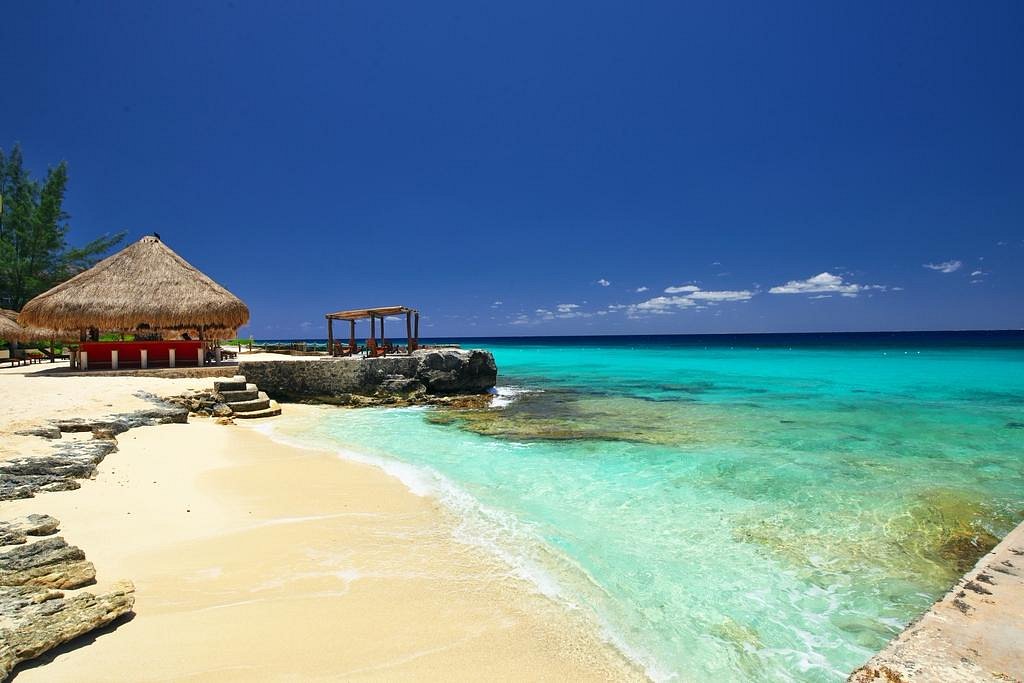
Cozumel is left out for two reasons. Reaching it takes a ferry from Playa del Carmen and then transport across the island, and much of its west coast is ironshore, a hard limestone shelf rather than soft sand, so many hotels rely on decks, ladders or imported sand for entry into the water. On water quality alone, many of its beaches facing Playa del Carmen stay clear most of the year, as they are naturally sheltered.
Playa San Francisco, on the sheltered west coast, is the most family-oriented beach we know of in the region. The sand is white and free of rocks at the water's edge, which is unusual on Cozumel, and the beach club has an inflatable water park offshore, plus kayaks, paddleboards, floating mats, snorkel gear and a pool. Day passes start at about $20 and include loungers, umbrellas, bathrooms, showers and wifi. The club is open 9 a.m. to 5 p.m., with a free public access point next door. There is no public transport, so book a taxi both ways and arrange the return in advance, as taxis are scarce. Secrets Aura Cozumel and Sunscape Sabor Cozumel are on this stretch.
San Miguel waterfront and Cozumel Norte. The town waterfront, beside the ferry pier, is the island's hub for shops, restaurants and dive operators rather than a beach: it is a seawall promenade, and the water is reached by steps and ladders. North of town, a strip of resorts faces the same sheltered channel. Along both, most of the shore is rock rather than sand, so hotels there rely on decks and ladders rather than beaches.
See the live card for Playa San Francisco → · San Miguel waterfront → · Cozumel Norte →
A note on how to use this
A ranking is a starting point, not a forecast. All five have had sargassum and will again; what sets them apart is how rarely it happens and how quickly it clears. That pattern cannot tell you about the week of your trip.
Use this list to narrow the search, then check the beach. Each has a card with dated photographs, live cameras and the current reading, and the live map compares them side by side.
Some links to hotels and activities are affiliate links. We are not affiliated with any tourism group or government agency.
Conditions change quickly. Please treat this as one input among several and carry out your own research before committing to a trip.